models
JET JWDS-1020 buyer guide
The JET JWDS-1020 makes sense when ordinary parts are narrow but an occasional panel exceeds a benchtop machine’s drum. Its attraction is the documented open-end capacity, not a promise that every panel will be quick to process. This guide evaluates published specifications and buying tradeoffs; it does not report a hands-on test.
As an Amazon Associate I earn from qualifying purchases. “Check Amazon” links are affiliate links.
Inspect the exact model offer
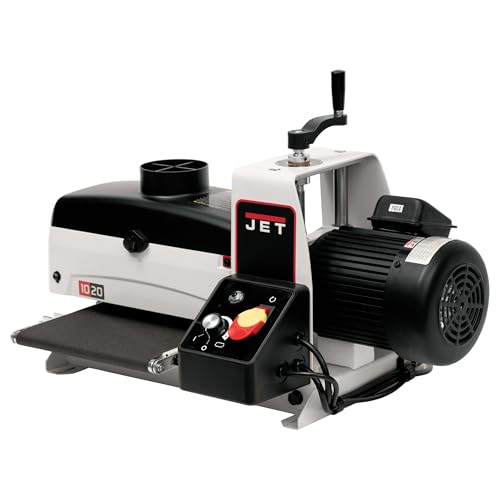
Check exact model, included equipment and current seller details.
Check AmazonWho should consider it
Start with the work you repeat: small drawer components, box panels, instrument parts, and narrow glued assemblies. If most of these fit beneath the drum, the compact format can be useful. If a large share requires turning the panel for a second pass, compare a wider machine before committing bench space. A low purchase footprint can still carry a high handling cost when nearly every job is wider than the drum.
Published capacity and what it means
JET’s US manual establishes 10 inches in one pass and 20 inches in two, with a 1/32-to-3-inch thickness range and a 2-3/8-inch minimum length. The same manual identifies a 1 HP, 115V machine and specifies a 4-inch dust port with 550 CFM recommended extraction. These are the relevant figures; some current web-page fields contain contradictory motor information and broken fraction formatting.
The detail that changes the decision
Two-pass work deserves its own test piece. The exposed side makes width possible, but alignment and support determine whether the overlap blends cleanly. A 19-inch panel is therefore a different workflow from a 9-inch panel even though both are within published capacity. Measure thickness at multiple points across the panel rather than judging the surface only by appearance.
Check the complete product offer
Affiliate link. Confirm the version, specifications and included accessories before purchase.
Check AmazonPlan the complete purchase
Treat the supporting bench as part of the purchase. It needs to hold the machine securely and provide working height, room for hose routing, and clear access to both sides. If you expect to move it frequently, plan that movement around the actual load and mounting arrangement. Benchtop describes installation, not effortless portability.
Include consumables and setup time in the budget. Price several useful abrasive grits, the correct dust hose and fittings, a reliable thickness gauge, and whatever stock support your layout requires. Ask how returns work after assembly and who supplies replacement wear parts. A quote that answers those questions is more useful than a bare advertised price, especially when two sellers offer different packages under the same model name.
Set a baseline in your own shop
Before your first valuable piece, make a simple acceptance sample from sound scrap that meets all of the confirmed stock limits. Mark its starting thickness in several locations, use a conservative sanding setup, and inspect the surface under angled light. Keep notes on the abrasive and material. This creates a repeatable reference for your own machine without assuming a manufacturer specification promises a particular finish.
Compare the nearest alternatives
Compare with the WEN 65911 and Grizzly G0716 for narrow work, but notice that their verified usable-width figures and minimum thicknesses differ sharply. Compare with JET’s 1632 when your usual panels exceed ten inches. Choose the 1020 because its documented envelope matches your parts, not because all ten-inch sanders appear interchangeable.
Questions, answered
Is the JWDS-1020 a 20-inch single-pass sander?
No. JET documents 10 inches in one pass and 20 inches using two passes.
Can it sand loose veneer at 1/32 inch?
The thickness rating alone is insufficient. Follow the manual’s carrier/backer guidance and verify the stock is suitable before feeding thin material.

