models
JET JWDS-1632 buyer guide
The JET JWDS-1632 is worth examining when your regular work fits a sixteen-inch drum and you want documented capacity for occasional wider panels. The buying question is how often the machine will run within its single-pass width. This is a source-based guide, with practical selection advice rather than a claim of measured shop performance.
As an Amazon Associate I earn from qualifying purchases. “Check Amazon” links are affiliate links.
Inspect the exact model offer

Check exact model, included equipment and current seller details.
Check AmazonWho should consider it
List the widths of your next ten jobs. A collection of cabinet parts, drawer fronts, and medium cutting boards may fit this machine well. A collection of broad table panels may lead you elsewhere. The 1632’s place in a shop depends less on the most impressive possible panel and more on the number of daily pieces it can process without repositioning.
Published capacity and what it means
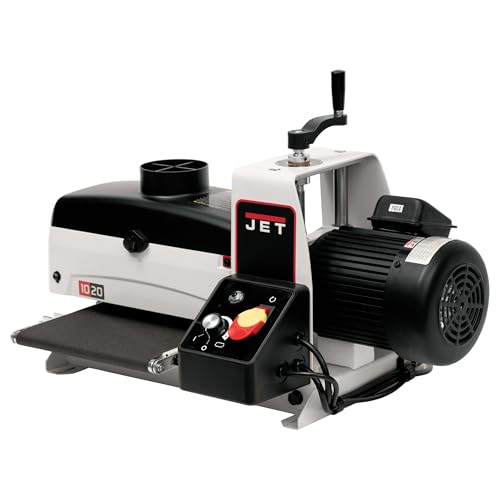
The official manual lists a 16-inch single pass, 32-inch two-pass capacity, 3-inch maximum thickness, 1/32-inch minimum thickness, and 2-3/8-inch minimum length. US power is 115V; the drum motor is rated 1-1/2 HP. The current manual specifies a 4-inch port and 400 CFM minimum extraction, with a recommended 20A circuit.
The detail that changes the decision
The ordinary 1632 does not gain oscillation merely because an OSC version exists. SandSmart feed-load management and drum-to-conveyor alignment are useful features to understand during a demonstration, but neither substitutes for a sensible abrasive choice or a light cut. Ask the seller to show where each adjustment is made and how a novice can return the machine to a known baseline.
Check the complete product offer
Affiliate link. Confirm the version, specifications and included accessories before purchase.
Check AmazonPlan the complete purchase
The stand, extension tables, mobile base, and abrasive stock should be priced as one working system. Photos often include helpful accessories that are not in the quoted package. A beginner gains more from having stable support ready on installation day than from buying a machine first and discovering that a long board has nowhere to land.
Include consumables and setup time in the budget. Price several useful abrasive grits, the correct dust hose and fittings, a reliable thickness gauge, and whatever stock support your layout requires. Ask how returns work after assembly and who supplies replacement wear parts. A quote that answers those questions is more useful than a bare advertised price, especially when two sellers offer different packages under the same model name.
Set a baseline in your own shop
Before your first valuable piece, make a simple acceptance sample from sound scrap that meets all of the confirmed stock limits. Mark its starting thickness in several locations, use a conservative sanding setup, and inspect the surface under angled light. Keep notes on the abrasive and material. This creates a repeatable reference for your own machine without assuming a manufacturer specification promises a particular finish.
Compare the nearest alternatives
The closest JET comparison is the 1836: identify which of your parts fall between sixteen and eighteen inches before paying for extra width. The 1632OSC addresses an interest in oscillation while retaining the same nominal capacity. SuperMax’s 16-32 offers another documented width match, so compare controls, service access, and delivered package contents instead of relying on the shared numbers.
Questions, answered
Does 32 in the name mean a 32-inch drum?
No. The drum’s working single-pass width is 16 inches; the manufacturer documents 32 inches in two passes.
Is the JWDS-1632 oscillating?
This standard model is distinct from the JWDS-1632OSC. Confirm the complete model name on the invoice.