comparisons
JET JWDS-1020 vs VEVOR 10-inch MS3126
Choose the JET JWDS-1020 if your purchase depends on a documented twenty-inch two-pass capacity or a verified minimum board length. Consider the VEVOR ten-inch MS3126 when your work stays inside its listed ten-inch width and the seller resolves its missing stock and extraction details. Neither conclusion assumes a measured finish-quality advantage: this comparison uses manufacturer documentation, not hands-on testing.
As an Amazon Associate I earn from qualifying purchases. “Check Amazon” links are affiliate links.
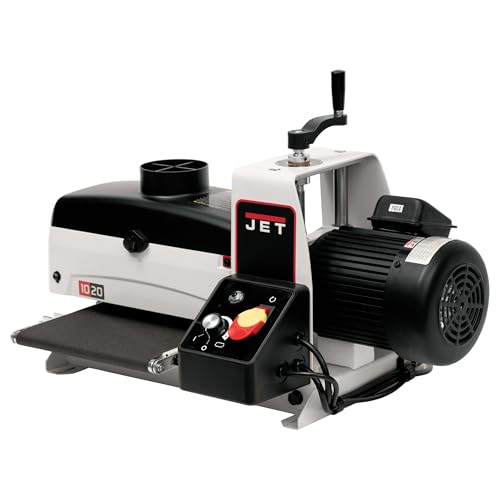
Confirm the exact version and included equipment.
Check Amazon
Confirm the exact version and included equipment.
Check AmazonSide-by-side buying comparison
A missing specification is not an unlimited capacity. Check the exact manual, model generation and seller package.
| Decision point | JET JWDS-1020 drum sander | VEVOR 10-inch MS3126 drum sander |
|---|---|---|
| Single-pass width | 10 in | 10 in |
| Documented two-pass width | 20 in | Not confirmed |
| Minimum stock thickness | 0.03125 in | 0.03125 in |
| Maximum stock thickness | 3 in | 3 in |
| Minimum stock length | 2.375 in | Not confirmed |
| Documented supply voltage | 115V | 110V |
| Documented dust airflow | 550 CFM | Not confirmed |
| Current Amazon offer | Check Amazon | Check Amazon |
Specifications are documented limits, not our test results. Supply voltage does not establish phase or circuit suitability.
The same size label hides a different buying proposition
Both are bench-format conveyor drum sanders for flat woodworking stock. A horizontal abrasive drum works above a moving feed belt; these are not floor-refinishing machines or spindle sanders for inside curves. The useful starting point is the size of the assembled workpiece when it reaches sanding, which may be larger than its final trimmed dimensions.
The exact VEVOR comparison is MS3126, US listing 010880135943, represented by the catalog offer linked on this page. Do not transfer details from the sixteen-inch stand model because a selector or review page shows it nearby. Likewise, compare the current US JWDS-1020 package rather than assuming older JET machines with similar names are identical.
JET has the documented over-width option
JET’s official manual establishes ten inches in one pass and twenty inches using two passes. The reviewed VEVOR specification establishes a ten-inch maximum workpiece width; a twenty-inch two-pass rating was not verified. This distinction is decisive for a buyer whose regular project is a sixteen-inch panel. The JET has documentary support for that width; the VEVOR comparison does not.
Even the JET’s twenty-inch number entails a separate workflow. A wide panel must follow the prescribed open-end method, with the overlap and thickness checked afterward. If nearly all your work exceeds ten inches, compare the cost of a wider single-pass machine too. Repositioning one occasional panel is different from doing it throughout every sanding session.
Thin and short stock require different checks
Both reviewed sources list thickness from 1/32 to three inches, but matching that range does not establish identical feeding limits. JET documents a 2-3/8-inch minimum board length. VEVOR’s minimum length was not verified. A comparison tool should display that missing value as a question requiring an answer, not accept any short blank because its width fits.
The minimum thickness also needs context. A very thin piece is not automatically suitable to feed loose simply because its thickness equals a catalog minimum. Read the matching manual and obtain any required carrier or backing guidance. If small instrument parts or thin strips are the main reason for buying, resolve the entire stock envelope before choosing either machine.
Check the complete product offer
Affiliate link. Confirm the version, specifications and included accessories before purchase.
JET JWDS-1020 drum sander
Check AmazonVEVOR 10-inch MS3126 drum sander
Check AmazonA benchtop purchase still needs a complete station
JET’s US manual specifies 115V power and a four-inch dust port with 550 CFM recommended extraction. VEVOR lists 110V/60Hz power and a four-inch connection, but a numeric airflow requirement was not verified. A matching port diameter is therefore not evidence that the same extraction setup is adequate for both. Ask for the MS3126 requirement tied to the supplied manual.
Plan the supporting bench and clear workpiece route before delivery. Include hose bends, access for abrasive changes, and room at the infeed and outfeed sides. If the bench also serves assembly work, count the space occupied while the sander is installed. Benchtop describes the mounting format; it does not promise that frequent lifting and storage will be convenient.
Compare the delivered package and the second abrasive order
Ask each seller for the exact included equipment, shipping service, damage-report procedure, and return conditions after assembly. Compare the complete cost using current quotations rather than a remembered sale price. Any needed bench reinforcement, stock support, dust fittings, and initial abrasive supply belong in that calculation. No current-price or durability ranking is asserted here.
Then ask a more revealing ownership question: how will you obtain the next abrasive wrap and a replacement conveyor? Confirm part numbers, dimensions, and the support contact for the actual model. A shared ten-inch label does not prove consumable interchangeability. VEVOR’s multiple variants make keeping the model and listing numbers with the receipt especially useful.
Make the final choice around the job you can verify
JET is the clearer fit when documented two-pass width or short-stock limits decide the purchase. VEVOR remains a candidate for confirmed narrow work if the completed package and support answers suit your budget. If the missing minimum length or extraction specification remains unresolved and that requirement is central to your work, keep looking rather than filling the gap with an assumption.
Before processing valuable material, establish a baseline on sound scrap that meets every applicable limit. Record thickness across the piece and inspect under angled light. Use that sample to learn your own machine and identify setup problems early. It is an acceptance exercise for the purchased unit, not evidence that one brand necessarily produces a better surface than the other.
Questions, answered
Can both machines sand a sixteen-inch panel?
JET documents the necessary two-pass width. The reviewed MS3126 listing does not establish an equivalent over-width capacity.
Does VEVOR’s unknown minimum length mean it accepts smaller parts?
No. It means the limit was not verified. Request the matching manual and manufacturer confirmation before selecting it for short stock.
Are both machines plug-and-play on my existing dust hose?
A fitting match is only one requirement. Verify extraction performance and routing; JET specifies 550 CFM, while the reviewed VEVOR material did not establish a numeric requirement.