comparisons
Oscillating Drum Sanders: Is the Feature Worth It?
An oscillating conveyor drum sander adds lateral movement to the sanding head. It remains a machine for feeding suitable stock beneath a horizontal drum. Evaluate oscillation as one feature within an appropriately sized sander, rather than as a substitute for extraction, correct abrasives, or sound setup.
As an Amazon Associate I earn from qualifying purchases. “Check Amazon” links are affiliate links.
A relevant product to inspect

Check exact model, included equipment and current seller details.
Check AmazonWhat the motion is intended to do
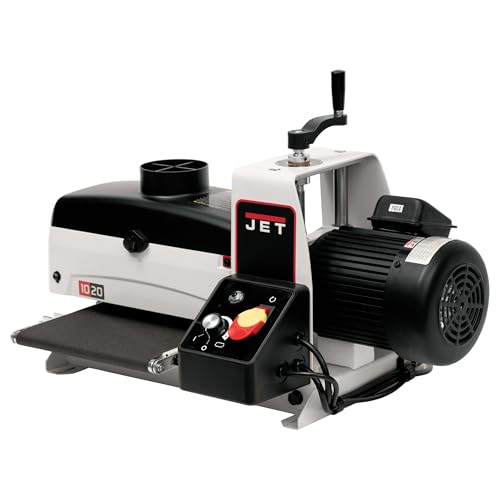
JET describes the JWDS-2244OSC head as moving left and right in oscillating mode, with the aim of reducing heat buildup, loading, and burning. These are manufacturer claims about the design, not comparative results from our own testing. They do not establish a measured improvement for your wood or sanding sequence.
The distinction from a spindle sander is important. A spindle machine presents a vertical sleeve and commonly oscillates up and down while the operator guides a curved edge. Both can be called oscillating sanders, but they address different surfaces and have different work handling.
Start with the underlying machine
Before assigning value to oscillation, compare usable width, thickness and length limits, feed control, adjustment access, and dust connection requirements. If those do not fit the job, the extra motion will not solve the mismatch. A machine that accommodates your panels comfortably may be preferable to an oscillating model that complicates every feed.
Inspect how oscillation is enabled and what the manual says about its adjustment and maintenance. Confirm whether the documented operating modes fit your intended process. Ask the dealer which consumables and service parts are shared with related models and which are unique to the oscillator.
Judge the result at the finishing stage
A convincing demonstration uses the same species, width, grit sequence, and target removal you expect to use. Ask to compare surfaces under angled light and assess the sanding needed before your intended finish. A feature that changes the visible scratch pattern is valuable only if that change helps the actual next step.
Keep depth, abrasive condition, and extraction in the comparison. If several settings change at once, you cannot attribute the result to oscillation alone. A favorable demonstration on narrow softwood also cannot establish performance on your wide hardwood panels.
Check the complete product offer
Affiliate link. Confirm the version, specifications and included accessories before purchase.
Check AmazonBalance benefit against added complexity
An oscillating mechanism adds moving components and its own service considerations. That is a reason to inspect documentation and support, not a prediction that the machine will fail. Ask about access, replacement parts, and the procedures required to keep the head operating correctly.
For intermittent shop use, spending first on adequate width, extraction, and work support may produce more practical value. For repetitive sanding where finish refinement consumes labor, oscillation may warrant a closer demonstration. Make the purchase conditional on a useful result for your process rather than treating the feature as an automatic quality tier. Continue using the operating limits and abrasive procedures in the exact manual; lateral movement does not authorize more aggressive settings or unsuitable material.
Set a meaningful acceptance standard
Define the result you want before the demonstration: fewer visible scratches after a specified preparation step, a cleaner surface on a particular wood, or reduced rework. Record which observations would justify the feature premium. This keeps a visually impressive mechanism from standing in for a measurable benefit in your shop.
Questions, answered
Will oscillation prevent burning?
It may help reduce heat buildup according to the manufacturer, but it does not guarantee burn-free sanding. Abrasive condition, feed, depth, material, and extraction still matter.
Is an oscillating drum sander a spindle sander?
No. A conveyor drum head moves laterally over feeding stock; a spindle sander is used against a vertical abrasive sleeve for contours.