comparisons
Open-End vs Closed-End Drum Sanders
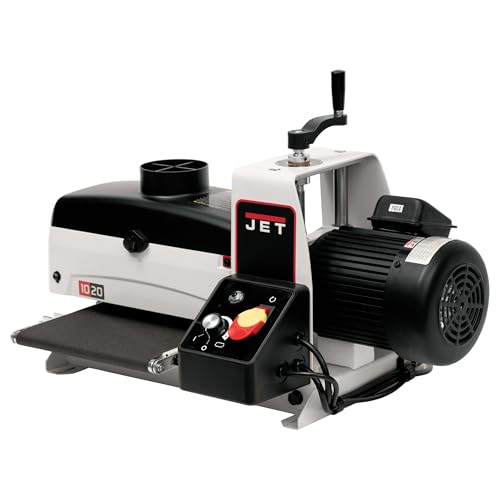
An open-end drum sander leaves one side of the sanding opening accessible so an approved oversized panel can extend beyond the drum. A closed-end machine limits passage to its opening. That distinction affects width flexibility, but it does not establish which individual machine is more accurate.
As an Amazon Associate I earn from qualifying purchases. “Check Amazon” links are affiliate links.
A relevant product to inspect

Check exact model, included equipment and current seller details.
Check AmazonSeparate head design from cabinet style
Product titles often mention an open stand or closed stand. Those terms describe the base beneath the sander. They do not necessarily describe the sanding opening. Look at the head and consult the manual to confirm whether work can extend past one end of the drum.
The distinction matters when scanning used listings or retailer bundles. A seller may photograph a cabinet base and call the machine enclosed, while the actual sanding head is open-ended. Ask for the complete model identification and photographs of the feed opening instead of inferring capacity from stand appearance.
What two-pass capacity actually means
An open-end machine may be rated for sanding a wider panel by processing one portion, repositioning the panel, and processing the other. The SuperMax 19-38 documentation illustrates this kind of capacity and provides its own alignment procedures. The wider figure should not be read as a single-pass width.
Repeated handling adds time, and the overlapping region requires careful setup. Wide panels also need appropriate support outside the conveyor footprint. If nearly every job uses the advertised maximum two-pass width, compare a machine that handles those panels in one pass before deciding that nominal capacity alone solves the task.
Compare adjustment and support
Ask how drum-to-conveyor parallelism is checked and adjusted on each candidate. Look for a clear manual procedure and accessible controls rather than accepting broad claims about rigidity. A heavy closed-end machine can still be misadjusted; an open-end machine can produce useful results within its intended operation.
For the exact model, inspect whether the two-pass procedure changes the setup used for ordinary narrow stock. Consider how often you would switch between those jobs and how you will verify the result. Convenience is valuable when it saves a repeatable setup task, but it should be judged from the actual mechanism.
Check the complete product offer
Affiliate link. Confirm the version, specifications and included accessories before purchase.
Check AmazonChoose for your width distribution
Measure a representative sample of work: everyday boards, regular glue-ups, and exceptional panels. An open-end sander can make sense when most stock fits under the drum and occasional wider work justifies additional handling. A closed-end sander can make sense when its opening covers the work and the complete machine meets your other needs.
If the only reason for extra capacity is a speculative future project, compare the cost of having that panel sanded elsewhere. Conversely, do not deliberately undersize a machine for panels you already make every week. Request a demonstration spanning the overlap region, then inspect thickness across the width and the surface under angled light. This is a purchase evaluation you can request, not evidence of a test performed for this guide.
Inspect the overlap on a real panel
A sample narrower than the drum cannot demonstrate two-pass behavior. Bring a suitable panel wide enough to cross the overlap region and agree with the dealer on the intended procedure. Ask to keep the sample so you can evaluate the surface under your own finishing light and compare it with your acceptance standard.
Questions, answered
Can all open-end sanders handle twice their drum width?
No. Use the stated maximum and procedure for the exact model; an open side is not permission to invent a capacity.
Are closed-end sanders automatically more accurate?
No. Head support is one design factor. Alignment, conveyor condition, work support, and operating technique still influence results.