comparisons
SuperMax 19-38 vs 25-50: When Wider Panels Matter
The SuperMax 25-50 is worth its larger installation when ordinary panels exceed nineteen inches and fit within twenty-five. The 19-38 can cover much of the same narrower work without buying capacity for exceptional projects. Both are single-drum conveyor sanders with documented wider-panel procedures, and neither should be confused with similarly sized brush or double-drum equipment.
As an Amazon Associate I earn from qualifying purchases. “Check Amazon” links are affiliate links.
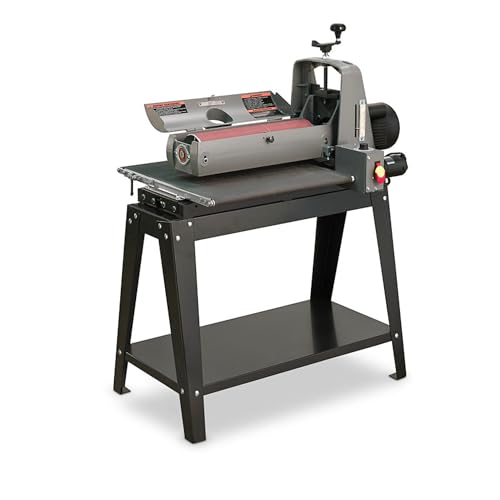
Confirm the exact version and included equipment.
Check Amazon
Confirm the exact version and included equipment.
Check AmazonSide-by-side buying comparison
A missing specification is not an unlimited capacity. Check the exact manual, model generation and seller package.
| Decision point | SuperMax 19-38 drum sander | SuperMax 25-50 drum sander |
|---|---|---|
| Single-pass width | 19 in | 25 in |
| Documented two-pass width | 38 in | 50 in |
| Minimum stock thickness | 0.03125 in | 0.03125 in |
| Maximum stock thickness | 4 in | 4 in |
| Minimum stock length | 2.25 in | 2.25 in |
| Documented supply voltage | 110V | 110V |
| Documented dust airflow | 600 CFM | 600 CFM |
| Current Amazon offer | Check Amazon | Check Amazon |
Specifications are documented limits, not our test results. Supply voltage does not establish phase or circuit suitability.
Six extra inches change a specific group of jobs
The 19-38 documents nineteen inches in a single pass and thirty-eight inches using two. The 25-50 expands those limits to twenty-five and fifty inches. A twenty-four-inch glued panel illustrates the difference clearly: it needs the wider-panel procedure on the 19-38 but fits inside the larger model single-pass capacity. A forty-two-inch panel is beyond the smaller machine maximum.
Count your confirmed projects in those width bands. If nearly all parts are eighteen inches or less, the extra capacity may be an infrequent convenience. If twenty-to-twenty-five-inch panels dominate production, it addresses a recurring handling step. Do not estimate a speed increase from the width ratio; the specification describes acceptance, not tested batch output.
Stock length and thickness are not upgraded
The cited manuals give both machines a 1/32-to-four-inch thickness range and a 2-1/4-inch minimum length. The 25-50 therefore adds width without extending those other documented limits. A short component unsuitable for the smaller model is not made suitable merely by moving to a longer drum.
Assess the construction and support of thin or flexible work using the applicable instructions. The minimum thickness does not guarantee successful sanding of every loose veneer or veneered assembly. Similarly, the four-inch maximum opening is only one part of evaluating a thick workpiece. Keep width, length, thickness, and the intended sanding operation together when deciding which projects genuinely justify the larger machine.
The cited utility requirements match
Both US manuals specify 110V single-phase 20A service, a four-inch dust port, and a minimum recommended collector capacity of 600 CFM. Both explicitly prohibit rewiring the machine for 220V. Follow the instructions for the supplied model rather than assuming a larger sander can be converted because another shop machine can.
The matching airflow recommendation does not prove that an existing collector setup is adequate for either machine. Account for hose, fittings, filter condition, and system resistance, and consult the supplier if delivered performance is uncertain. Also plan the electrical arrangement with the collector operating at the same time. Infrastructure belongs in both purchase totals even though these headline requirements do not distinguish the pair.
Check the complete product offer
Affiliate link. Confirm the version, specifications and included accessories before purchase.
SuperMax 19-38 drum sander
Check AmazonSuperMax 25-50 drum sander
Check AmazonFifty-inch capacity makes handling a buying issue
The 25-50 allowance is achieved through two passes, not a fifty-inch sanding cylinder. A broad panel still needs appropriate support, side clearance, and a route back to the infeed after its first traversal. At this width, the shape and weight of the work can influence shop suitability as much as the machine base.
Rehearse that route with a representative unpowered workpiece before placing an order. For the 19-38, do the same with your largest permitted panel rather than assuming thirty-eight inches is automatically easy to manage. If your regular work is twenty-four inches, a 25-50 single-pass demonstration is a more relevant buying exercise than watching either machine sand a narrow board.
Check stand variants and the cost of ownership
Laguna lists open-stand and closed-stand 25-50 versions; the cited 2024 manual identifies SUPMX-72550-OP on its cover. Confirm the exact stock number and included stand for the linked offer, then itemize casters, readout, support tables, and delivery arrangements. Do the same for the 19-38 instead of treating photographs as binding package descriptions.
Price compatible abrasive wraps and conveyor parts by model. Ask to see service access around the drum ends and the steps required for common wear-component replacement. A wider machine can fit the operating location while leaving insufficient room for maintenance. No current price advantage or abrasive-life multiplier is asserted here; compare current quotes for the complete installations and consumables you will actually use.
Final choice: buy for repeated panels, not the largest headline
Choose the 19-38 when most work fits nineteen inches, its thirty-eight-inch two-pass limit covers your exceptions, and the installation works comfortably. Choose the 25-50 when recurring nineteen-to-twenty-five-inch panels or confirmed wider projects justify the additional width and handling space. The shared thickness and utility figures mean those issues do not independently argue for the larger model.
If nearly everything exceeds twenty-five inches, compare repeated two-pass drum sanding with an appropriately sized alternative or outsourcing before assuming the 25-50 completes the decision. It remains a single-drum machine, distinct from SuperMax 25x2 equipment. Ask for a representative demonstration, inspect the surface and thickness, and choose the configuration that serves the process you will repeat rather than the maximum number printed in the name.
Questions, answered
Does the 25-50 have two sanding drums?
No. The 25-50 compared here is a single-drum sander with a fifty-inch two-pass allowance. It is distinct from SuperMax 25x2 equipment.
Will the 25-50 accept thicker or shorter stock than the 19-38?
Not by the cited specifications. Both list 1/32-to-four-inch thickness and a 2-1/4-inch minimum length, subject to the applicable handling instructions.
Is the larger model documented for 220V conversion?
No. The cited US 25-50 and 19-38 manuals specify 110V single-phase 20A service and explicitly prohibit rewiring for 220V.